2. Paste this code immediately after the opening tag:

ASUG SPRING CHAPTER MEETING – Georgia

Discover how Pinnacle Consulting spearheaded a monumental foundational upgrade from SAP ECC On-Premises to SAP S/4HANA RISE PCE for an industry giant.

Event Association: ASUG Spring Chapter Meeting – Georgia

Session Formats: Case Study Presentation, Technical Q&A, and Interactive Booth Demos

Pinnacle Event Location: Visit the Pinnacle Consulting Exhibition Booth

Featured Speakers:

K. Srinivas Rao

CEO, Pinnacle Consulting

Randy Fredericks

Technology Lead, Leading Construction Enterprise

About the Event

As mainstream support for legacy SAP systems nears its end, enterprise leaders must look beyond basic “lift-and-shift” strategies to secure their digital future. At the upcoming ASUG Georgia Spring Chapter Meeting, Pinnacle Consulting will deliver an exclusive, deep-dive technical case study showcasing a landmark cloud transformation.

This session spotlights how Pinnacle partnered with a premier, multi-billion-dollar North American infrastructure and construction enterprise to execute a complex “Brownfield Plus” migration from SAP ECC On-Premises to SAP S/4HANA RISE PCE. Attendees will learn firsthand how our engineering teams navigated a massive landscape consisting of over 10 core systems, 130+ integrated application ecosystems, and more than 6,000 custom RICEFW objects, all while embedding strict NIST security compliance and advanced platform governance from day one.

What to Expect

This session bypasses high-level theories to deliver raw architectural challenges, tactical solutions, and proven migration benchmarks:

  • Real-World Discovery Strategies: Learn why relying on standard SAP sandbox environments fails to account for company-specific configurations, and how upgrading a live production clone accelerates the entire scoping phase.
  • Advanced Data Shrinking Techniques: Discover how Pinnacle’s custom data archival programs compressed 15 years of massive production data into a clean, 13-month subset—shrinking a 3.75TB system down to 800GB in just 5 weeks to fast-track code remediation.
  • Cloud Security Hardening: Understand how to properly integrate required NIST controls, harden SAP BTP and Identity Authentication Services (IAS), configure secure Microsoft Entra ID single sign-on, and enable Microsoft Sentinel for continuous threat detection.
  • Post-Conversion Transformation Ecosystems: See how automated parallel programs compressed a massive transition from ECC WM to Embedded Extended Warehouse Management (EWM) in just 12 hours , alongside the step-by-step consolidation of standalone on-premises CRM systems into RISE PCE.
  • Downtime Minimization Frameworks: Gain key insights on running rapid, iterative cutover rehearsals with SAP to optimize SUM performance and clear rigid business continuity benchmarks.

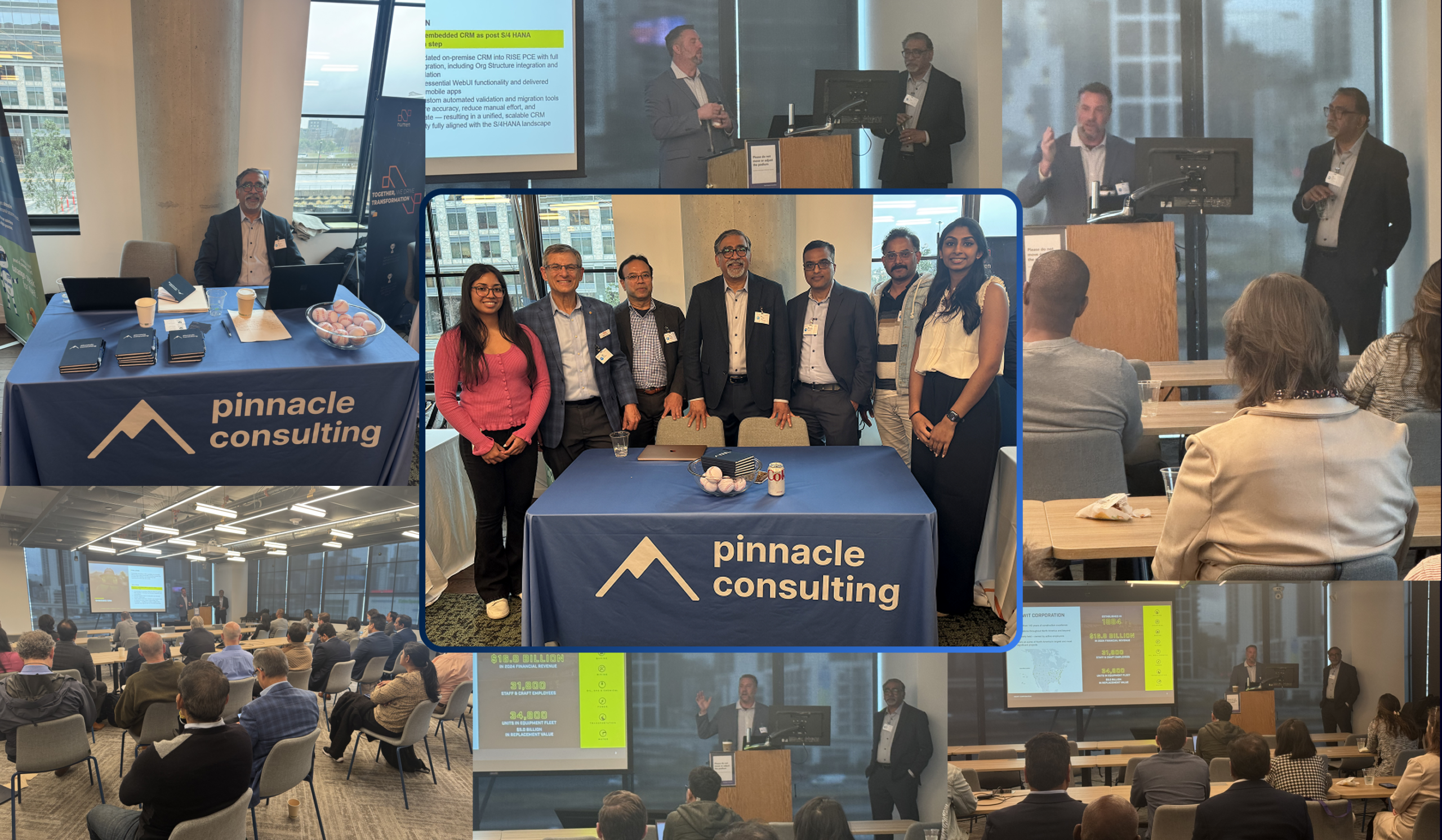
Snippets from the Event

Ready to Transform Your Enterprise?

Schedule a consultation with our leadership team to discuss your transformation goals and explore how Pinnacle Consulting can help you achieve measurable outcomes.

SAP ENTERPRISE ARCHITECT DAYS OF LEARNING – Atlanta

Discover how Pinnacle Consulting and the Enterprise Architect SAP Community came togeather to provide key insights from SAP TechEd 2025 and explore real-world innovation.

Date: Tuesday, December 16, 2025

Time: 1:00 PM – 5:30 PM ET

Location: SAP Atlanta | 3500 Lenox Road, Ste T12, Atlanta, GA 30326

About the Event

Attendees will gain access to direct tactical strategy, collaborative crowdsourcing, and next-generation roadmaps:

  • SAP TechEd 2025 Key Takeaways: Dive deep into fresh technical insights and critical architectures that matter most to enterprise leaders.
  • SAP Multidimensional Architect Program: Get a specialized look at the latest frameworks transforming modern architecture.
  • Peer-to-Peer Networking: Share challenges and co-create future strategies alongside architects from SAP, fellow partners, and leading regional enterprise customers.
  • Shaping 2026 Priorities: Participate in a collaborative crowdsourcing session to directly influence community objectives and program features for the upcoming year.
  • Architect-to-Architect Reception: Cap off a year of collective learning with a festive pre-holiday networking reception.

Event Schedule & Logistics

  • 1:00 PM: Welcome & Registration Check-in
  • 1:30 PM – 4:30 PM: Technical Briefings, Crowdsourcing, and Case Studies (Includes SAP TechEd Highlights and Pinnacle’s Featured Case Study: Innovation with RISE at Kiewit Corporation)
  • 4:30 PM – 5:30 PM: Pre-Holiday Architect-to-Architect Networking Reception

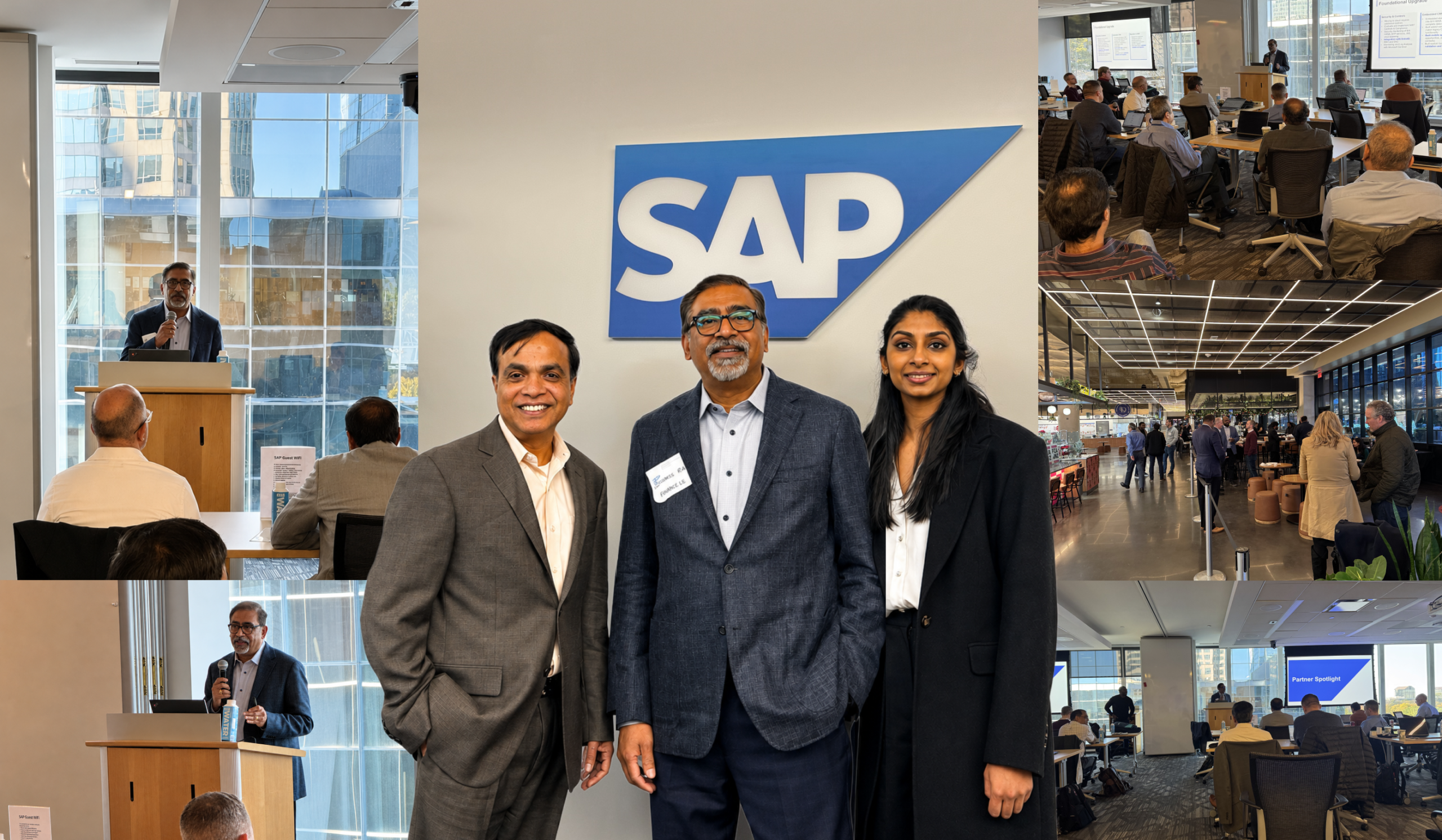
Snippets from the Event

Ready to Transform Your Enterprise?

Schedule a consultation with our leadership team to discuss your transformation goals and explore how Pinnacle Consulting can help you achieve measurable outcomes.

Why 2026 is the Make-or-Break Year for SAP S/4HANA Migration

The Migration Clock Is No Longer Theoretical

Mainstream maintenance for SAP Business Suite 7 ends in December 2027. That deadline is not new. What has changed is the pace of action around it. According to an ASUG/Precisely study released in late 2025, 59% of companies are now fully or partially live on SAP S/4HANA, an increase of 13 percentage points from 2024. SAPinsider's ERP Migration and Transformation 2026 Benchmark puts the figure at 55% deployed, with only 34% having fully completed their transitions. The gap between those two numbers tells the real story. An initial go-live is not the same as a completed transformation. Many organizations are running parallel systems, migrating in phases, and dealing with legacy integrations that turn what should be a switchover into a multi- year marathon. For the estimated 20,000 to 25,000 legacy SAP ERP customers who have not yet licensed S/4HANA, the window is closing fast. Most migration projects require 12 to 18 months of execution. That means organizations starting in mid-2026 are already at risk of missing the deadline without extended maintenance agreements.

AI Has Overtaken the Deadline as the Primary Driver

Here is the shift most organizations did not anticipate. According to the SAPinsider 2026 Benchmark, 43% of respondents now cite SAP's AI announcements as the primary external factor shaping their ERP strategy. The 2027 maintenance deadline, which dominated the conversation for years, dropped to second place at 39%. This is not abstract interest in AI. At SAP Sapphire 2026, the company announced the SAP Business AI Platform and the Autonomous Suite, deploying more than 200 specialized AI agents and 50 Joule Assistants across finance, supply chain, procurement, HR, and customer experience. SAP's Cash Management Agent, which became generally available in Q1 2026, has demonstrated the ability to reduce time spent on manual cash positioning by up to 80%. The practical implication is clear: organizations that treat S/4HANA migration as a compliance exercise are already behind. The companies

The Real Barriers Are Not Technical

The ASUG/Precisely survey identified the top migration barriers, and none of them are primarily
about technology:
Business process change (49%): Redesigning how work gets done is harder than
reconfiguring systems.
Customizations (44%): Aligning years of accumulated ECC customizations with SAP's
Clean Core approach requires difficult trade-offs.
Organizational resistance (37%): Cultural change at scale remains the most
underinvested area of transformation programs.
Data quality compounds all three. Organizations consistently report accuracy and
transformation issues when moving legacy data into S/4HANA environments. Poor data does
not just slow the migration; it undermines every AI use case the organization plans to build on
top of the new platform.

Budget Overruns Are the Norm, Not the Exception

According to ASUG research, 49% of organizations that are already live on S/4HANA reported costs exceeding their original budgets, a 17-percentage-point increase from 2023. Consulting fees are the primary source of unexpected costs, driven by a surge in demand for qualified implementation partners. The SAP consulting market exceeded $16 billion in 2025 and is projected to approach $39 billion by 2035. As thousands of organizations compete for the same limited pool of integration experts over the next 18 months, consulting rates have risen 30 to 50% in 2026. Organizations that delay locking in implementation partners risk both higher costs and stalled timelines.

What Successful Transformation Programs Do Differently

After three decades of advising Fortune 100 clients through enterprise transformations, the patterns that separate successful programs from troubled ones are consistent:

1. They Start with Readiness, Not Technology

The organizations that hit their timelines and budgets invest upfront in transformation readiness assessments. This means evaluating organizational readiness, stakeholder alignment, and business case development before selecting a migration path. Pinnacle Consulting's Enterprise Transformation Strategy practice begins every engagement with a structured readiness assessment that identifies risks, gaps, and dependencies before a single line of configuration is written.

2. They Build Roadmaps That Account for AI from Day One

Migration is no longer a standalone IT project. Forward-looking organizations are building their S/4HANA roadmaps with AI integration as a design constraint, not an afterthought. That means evaluating SAP BTP readiness, data quality for AI consumption, and governance frameworks alongside the core migration plan.

3. They Invest in Change Management as Heavily as Technology

Over 70% of digital transformation projects fail not because of technical problems, but because of resistance to change and insufficient adoption. Successful programs allocate dedicated resources for change impact assessments, communication strategies, training, and post-implementation value tracking.

4. They Maintain Continuity Across Strategy and Execution

One of the most common failure patterns in large transformations is the handoff gap: a strategy team develops the roadmap, then a different implementation team executes it. Critical context is lost, assumptions go unchallenged, and the program drifts from its original objectives. The most effective model keeps the same core team from strategy through go-live and post-implementation support.

Greenfield, Brownfield, or Hybrid: The Decision Framework

The choice of migration approach remains one of the most consequential decisions in any S/4HANA program. According to ASUG research, organizations are nearly evenly split: 34% pursuing brownfield strategies, 33% greenfield, and 20% hybrid. Each approach carries distinct trade-offs. Brownfield conversions preserve customizations and historical data but inherit technical debt. Greenfield implementations enable process optimization from scratch but require more time and investment. Hybrid approaches attempt to balance both, but add coordination complexity. The right choice depends on the organization’s specific landscape, customization footprint, business objectives, and timeline constraints. There is no universal answer, which is why transformation strategy must precede technology decisions, not follow them.

The Talent Bottleneck Is Real

SAPinsider’s 2026 report identifies a severe resource bottleneck forming as thousands of SAP customers rush to meet the 2027 deadline simultaneously. The demand for qualified system integrators and deployment partners is about to drastically outpace supply. This makes partner selection a strategic decision, not a procurement exercise. Organizations should evaluate implementation partners on depth of SAP expertise, breadth of functional and technical capabilities, track record with similar-scale transformations, and the ability to staff engagements with senior consultants who have seen the failure modes firsthand.

Frequently Asked Questions

What happens if my organization misses the 2027 SAP ECC end-of-maintenance deadline?
After December 2027, SAP ECC will no longer receive security updates, critical patches, or official technical support. Organizations can purchase extended maintenance, but at a premium. More critically, operating on an unsupported platform creates growing security vulnerabilities, regulatory compliance risks, and inability to access SAP’s AI and cloud innovations.
According to ASUG research, the average migration takes approximately 1.5 years from project initiation to go-live. However, this varies significantly based on the organization’s customization footprint, data complexity, integration count, and chosen migration approach. Organizations with 50 or more integration points should plan for longer timelines.
The answer depends on your specific circumstances. Brownfield preserves existing configurations but carries technical debt. Greenfield enables full process redesign but requires more investment. Hybrid balances both but adds complexity. A structured transformation readiness assessment should inform this decision before any technical work begins.
The primary drivers are consulting fee increases (rates up 30 to 50% due to demand), underestimated integration complexity, and insufficient planning for data quality remediation. Organizations that invest in thorough readiness assessments and lock in implementation partners early are better positioned to manage costs.
AI has become the top external factor shaping ERP strategy, ahead of the 2027 deadline. Organizations should evaluate their S/4HANA migration as the foundation for AI-powered operations, ensuring data quality standards, SAP BTP readiness, and governance frameworks are built into the migration roadmap from the start.

Prioritize partners with deep SAP expertise across functional and technical domains, a track record of Fortune 100 engagements, battle-tested methodologies, and a delivery model that maintains team continuity from strategy through post-go-live support. Senior-led teams with 20 or more years of experience can identify risks and failure modes that less experienced teams miss.

Ready to assess your transformation readiness?

Pinnacle Consulting helps organizations build transformation roadmaps grounded in 30+ years of enterprise experience. Schedule a consultation to evaluate your readiness, define your migration strategy, and build a plan that accounts for both the 2027 deadline and your AI ambitions.

8 SAP Consulting Capabilities That Separate Successful Transformations from Expensive Failures

The Partner Selection Problem No One Talks About

SAP transformations are among the most complex technology initiatives an organization can undertake. They touch every business function, require deep technical and functional expertise, and have consequences that persist for a decade or more. Yet most organizations select their implementation partner based on brand recognition, rate cards, and a well-rehearsed sales presentation. The results speak for themselves. According to SAPinsider research, over 60% of surveyed firms reported migration projects that exceeded budget, schedule, or both. ASUG found that 65% identified severe to very severe quality deficiencies after go-live. And 49% reported costs exceeding their original budgets. These outcomes are not random. They correlate directly with the breadth and depth of the implementation partner’s capabilities. A partner with deep technical skills but limited functional expertise delivers a system that works but does not align with business processes. A partner with strong consulting credentials but no hands-on delivery experience produces beautiful roadmaps that stall during execution. The organizations that consistently achieve successful outcomes are those that choose partners with capabilities spanning the full lifecycle: from strategy and readiness through implementation, quality assurance, and post-go-live optimization.

The 8 Capabilities That Matter Most

1. Data and Analytics

Every AI use case, every reporting requirement, and every executive dashboard depends on the quality and architecture of your data platform. This capability encompasses modern data architecture and cloud analytics platform implementation, SAP Analytics Cloud, Datasphere, and Business Data Cloud expertise, advanced analytics, predictive modeling, and machine learning integration, and real-time dashboards for data-driven decision-making. Without a strong data and analytics foundation, organizations cannot realize the value of their S/4HANA investment. The platform may be modern, but the insights it delivers will be only as good as the data feeding it.

2. Agentic AI and Automation

As SAP moves toward the Autonomous Enterprise vision with more than 200 specialized agents and 50 Joule Assistants, organizations need implementation partners who can deploy autonomous intelligent systems, not just configure traditional workflows.

This capability includes agentic AI systems for autonomous workflow execution, SAP Business AI and Joule integration, conversational AI and natural language processing, and intelligent document processing with audit automation. Partners with patented AI/ML innovations bring proven technology, not theoretical capability.

3. Security Assessments

Cybersecurity is not a standalone concern; it is a design constraint for every SAP transformation. The shift to cloud-based SAP environments changes the attack surface fundamentally. RISE with SAP customers operate under a shared responsibility model where SAP manages infrastructure security, but the customer owns application security, identity governance, custom code integrity, and compliance.

Comprehensive security assessment capability covers application, infrastructure, and data security assessments, NIST and SOX compliance framework gap analysis, penetration testing and vulnerability remediation planning, and security architecture design and implementation support.

4. Functional Expertise

SAP functional consultants are the bridge between business requirements and system configuration. Deep functional expertise across Finance, Supply Chain, HR, Manufacturing, and Sales ensures that the system is configured to support how the business actually operates, not how a generic implementation template assumes it should.

This includes business process design and fit-to-standard analysis, change management and organizational readiness support, and end-user training and adoption enablement. Functional expertise is the capability most directly correlated with post-go-live user adoption and satisfaction.

5. Business Portfolio Rationalization

Most enterprise organizations operate more applications than they need, accumulating technical debt through years of tactical purchasing decisions. Before adding new SAP capabilities, organizations need clarity on which systems to keep, retire, modernize, or consolidate.

Portfolio rationalization provides comprehensive application inventory and assessment, total cost of ownership analysis and cost optimization, application rationalization roadmaps with phased execution plans, and cloud migration readiness assessments. This capability prevents organizations from migrating problems to a new platform rather than solving them.

6. Licensing and Negotiation

SAP licensing is one of the most complex and consequential financial decisions in any transformation program. RISE with SAP bundles infrastructure, database, and platform fees into a subscription model. Indirect and digital access licensing adds additional complexity. Without expert guidance, organizations routinely over-license by 15 to 30%, locking themselves into contracts that do not reflect actual usage.

Licensing and negotiation capability includes SAP licensing optimization across RISE, indirect access, and digital access models, software contract review and vendor negotiation support, license utilization analysis and right-sizing recommendations, and audit response and compliance validation.

7. QA and Assessments

Independent quality assurance is the capability most frequently cut from transformation budgets and most frequently cited as a root cause of post-go-live failures. When the same team that builds the system also tests it, blind spots become structural.

Effective QA capability provides independent program health assessments with C-level visibility, comprehensive test strategy development and execution, risk-based testing prioritization and automation, and go-live readiness assessments with cutover planning. This is especially critical for organizations managing complex multi-system migrations with dozens of integration points.

8. Accelerators and Toolkits

Three decades of enterprise transformations produce more than expertise; they produce reusable assets. Migration accelerators and data validation tools, industry-specific playbooks for construction, manufacturing, and transportation, SAP implementation frameworks and BTP development templates, and test automation libraries reduce project time, cost, and risk.

These are not generic templates downloaded from a marketplace. They are proprietary tools refined through hundreds of real engagements, encoding lessons learned from both successes and failures.

Why Capabilities Work Better Together

The most critical insight about SAP consulting capabilities is that they are rarely applied in isolation. A security assessment informs the transformation roadmap. Data and analytics requirements shape the migration approach. QA findings trigger changes in functional configuration. AI use case priorities influence licensing decisions.

Partners who operate in capability silos, with separate teams for strategy, implementation, security, and testing, create seams where critical information falls through. Partners who integrate capabilities into a unified engagement model deliver outcomes that are more predictable, less risky, and more aligned with business objectives.

The Senior Leadership Advantage

One pattern consistently differentiates successful transformations from troubled ones: the seniority of the consulting team. Organizations where senior consultants with 20 or more years of experience are embedded across all teams report fewer surprises, faster decisions, and better outcomes.

Senior consultants have seen the failure modes. They know which customizations will create problems during migration, which integration patterns will break under load, which organizational dynamics will derail adoption, and which governance structures will scale. This pattern recognition cannot be replaced by methodology alone.

How to Evaluate Partner Capabilities

When assessing an SAP implementation partner, look beyond the sales pitch. Ask for evidence of each capability, not descriptions. Request references from organizations of similar size and complexity. Evaluate the specific individuals who will staff your engagement, not the firm’s aggregate credentials. And pay particular attention to the delivery model: will the team that develops your strategy also execute the implementation, or will there be a handoff?

The best partners combine breadth of capability with depth of expertise, a battle-tested methodology, and a delivery model built on continuity and accountability.

Frequently Asked Questions

Why do so many SAP migration projects exceed their budgets?
The primary causes are underestimated integration complexity, insufficient data quality remediation, consulting rate increases driven by talent scarcity, and scope expansion during implementation. Organizations that invest in thorough readiness assessments and partner with firms offering full-lifecycle capabilities are better positioned to manage these variables.
Functional consultants focus on business processes: how Finance, Supply Chain, HR, and Manufacturing operations should work within SAP and how the system should be configured to support them. Technical consultants focus on system architecture, custom development, data migration, integration, and infrastructure. Both are essential for successful transformations.
Highly important. Industry-specific experience means the partner understands the unique regulatory requirements, business processes, and competitive dynamics of your sector. A partner with construction industry experience, for example, understands project systems, capital project tracking, and compliance requirements that a generalist partner would need to learn on your budget.
There are strong advantages to using the same partner for both. The most common failure pattern in large transformations is the handoff gap, where critical context and assumptions are lost when a strategy team hands off to a different implementation team. Partners that maintain team continuity from strategy through post-go-live support deliver more predictable outcomes.
Look for evidence, not claims. Ask about patents, production deployments, and specific technical architecture. Partners with patented AI/ML innovations and demonstrated production deployments on SAP BTP bring proven capability. Partners who describe AI capabilities in general terms without specific examples may be positioning rather than delivering.
Battle-tested accelerators, including migration tools, industry playbooks, and testing frameworks, reduce project time, cost, and risk by codifying lessons learned from hundreds of prior engagements. They are especially valuable for reducing the effort required for data validation, regression testing, and go-live readiness assessment, which are areas where manual approaches consistently introduce delays.

Evaluate your transformation partner's capabilities

Pinnacle Consulting combines data and analytics, AI and automation, security, functional expertise, portfolio rationalization, licensing, QA, and battle-tested accelerators into a unified engagement model. Schedule a consultation to discuss how these capabilities apply to your transformation.

From Pilot to Production: Why Most Enterprise AI Projects Stall in the Sandbox

The Enterprise AI Execution Gap

The promise of enterprise AI has never been more tangible. At SAP Sapphire 2026, SAP launched the Autonomous Suite with more than 200 specialized AI agents and 50 Joule Assistants. Gartner predicts that 40% of enterprise applications will include task-specific AI agents by the end of 2026, up from less than 5% in 2025. Yet for most organizations, the reality looks very different from the headlines. According to Futurum Group’s 1H 2026 AI Platforms Decision Maker Survey of 820 organizations, 55% cite agent reliability and hallucination management as their top adoption challenge. The gap between AI ambition and AI execution is widening, not closing. The problem is rarely the technology itself. It is the infrastructure, governance, and organizational readiness required to move AI from a sandbox demonstration to a production system that handles real transactions, real data, and real business consequences.

Why Proof-of-Concepts Fail to Scale

Most enterprise AI initiatives follow a predictable pattern. A team identifies a promising use case, builds a prototype in an isolated environment, demonstrates it to stakeholders, and then watches it stall when the conversation turns to production deployment.

The failure points are structural, not technical:

Long IT Intake and Provisioning Cycles

Before a line of code is written, months can pass waiting for environment provisioning, security approvals, and data access. In SAP environments, where configuration complexity and integration dependencies are high, this friction is amplified. Innovation timelines shrink to zero while governance timelines expand.

Siloed Experimentation Without a Production Path

Many organizations build AI prototypes in sandbox environments that have no connection to production data, production integrations, or production security requirements. When the prototype works, the team discovers that the architecture, data pipeline, and governance model all need to be rebuilt for production. The prototype was a dead end dressed up as progress.

Scarce Talent with Dual SAP and AI Expertise

Enterprise AI in SAP environments requires a rare combination of skills: deep SAP functional knowledge (understanding business processes, configuration, and data models), technical AI/ML expertise (model development, training, deployment), and platform engineering skills (SAP BTP, cloud infrastructure, integration). Finding individuals or teams with all three is the bottleneck most organizations underestimate.

Undefined Success Criteria

Without measurable success criteria defined before development begins, AI projects drift toward perpetual optimization. Stakeholders lose confidence, funding decisions stall, and the initiative quietly dies. The most successful AI deployments define specific, quantifiable outcomes before writing a single line of code.

What Production-Ready Enterprise AI Actually Requires

Moving AI from concept to production in SAP environments demands a structured methodology that addresses four layers simultaneously:

A Dedicated Innovation Environment

Production-ready AI cannot be developed in production systems. It also cannot be developed in environments that bear no resemblance to production. The solution is a purpose-built innovation lab platform with pre-configured SAP and non-SAP systems that enable rapid prototyping without impacting production environments, while maintaining realistic data, integration, and security characteristics.

Foundational Architecture Patterns

Enterprise AI is not a single capability; it is a set of architectural patterns that can be composed and reused across use cases:

  • Agentic query and action: AI agents that interpret natural language, identify the correct SAP OData endpoint, construct the query, and return grounded answers.
  • Event-driven triggers: AI subscriptions to business events (purchase order created, goods receipt posted, invoice exception flagged) that enrich, route, or take action autonomously.
  • RAG with ERP grounding: Retrieval-augmented generation that grounds AI responses in actual SAP data (vendor masters, material descriptions, configuration notes) rather than allowing hallucinated ERP knowledge.
  • Human-in-the-loop with audit trail: Any AI pattern touching write operations requires a human confirmation step with full lineage capture before changes are committed to S/4HANA.

Governance from Day One, Not Day 100

AI governance is not a post-deployment concern; it is a design constraint. Organizations deploying AI agents in SAP environments need input sanitization (screening for prompt injection, PII, and policy violations), output validation (compliance, hallucination risk scoring, domain rule adherence), audit trails linking every AI action to source data and user identity, and human oversight checkpoints for irreversible operations. The EU AI Act compliance deadline for high-risk systems is August 2, 2026. Organizations that treat governance as optional are building a compliance liability alongside their AI capability.

A Team That Bridges SAP and AI

The most effective enterprise AI teams combine SAP functional architects who understand business process design, technical solution architects with SAP BTP and cloud platform expertise, AI/ML engineers who can build, train, and deploy models, security specialists who understand both SAP authorization models and AI-specific threats, and business analysts who translate user needs into measurable outcomes.

The Accelerate-Then-Scale Approach

Organizations that successfully move from pilot to production share a common pattern: they start narrow, prove value, and then scale systematically.

Phase 1: Accelerate

The initial phase focuses on a small number of high-impact use cases. The goal is not to build everything, but to prove the methodology: discover and prioritize use cases, build working prototypes, deploy to production, and demonstrate measurable value within a defined timeframe. Typical accelerate phases run 10 to 14 weeks with a dedicated cross-functional team.

Phase 2: Scale

Once the first use cases are in production and the methodology is proven, parallel sprint teams extend the approach across additional business domains. The architecture patterns, governance frameworks, and deployment pipelines built during the accelerate phase become reusable assets that dramatically reduce time-to-value for subsequent use cases. This two-phase structure solves the most common failure mode in enterprise AI: trying to do everything at once, delivering nothing of production quality.

Cognitive Finance: A Concrete Example

Pinnacle Consulting’s Cognitive Finance application demonstrates what production-ready enterprise AI looks like. Built on SAP BTP, it optimizes financial close processes through four integrated capabilities:
  • Process efficiency: AI-powered tie-out automation that recognizes financial data and validates it against approved sources, reducing manual effort and allowing teams to focus on exceptions.
  • Compliance automation: Automatic generation of SEC-required reports and supporting documents, with direct integration to SAP BTP for ERP data extraction.
  • Audit readiness: Automated audit trails linking AI actions to source data and logging employee actions for transparent, efficient external audits.
  • Predictive insights: A conversational interface that delivers financial insights using GenAI and external market data for predictive analysis, without requiring technical support.

This is not a proof of concept. It is a production application backed by patented AI/ML innovations, integrated with SAP systems, governed with audit trails, and delivering measurable results.

The Cost of Waiting

Every quarter an organization delays moving AI from sandbox to production, competitors are deploying autonomous workflows, reducing manual effort, and building institutional AI capability that compounds over time. The talent market for dual SAP-AI expertise is tightening. The regulatory environment is becoming more demanding. And the platforms themselves are evolving rapidly.

Organizations that establish their AI innovation infrastructure in 2026 will spend the next several years compounding returns. Organizations that wait will spend those years catching up.

Frequently Asked Questions

What is agentic AI, and how does it differ from traditional AI assistants?
Agentic AI refers to AI systems that can autonomously plan, select tools, execute multi-step tasks, and adapt their behavior based on outcomes, often without human intervention at each step. Traditional AI assistants respond to a single prompt and return a single output. Agentic AI operates more like a capable team member that can manage end-to-end workflows across multiple systems.
Yes. AI innovation does not require a completed migration. Organizations can begin with use cases that work alongside existing ECC systems, build on SAP BTP, or target specific processes where AI delivers value regardless of the underlying ERP version. The key is designing architecture patterns that will work across both the current and future state of your landscape.
Define measurable success criteria before development begins. Build in an innovation environment that mirrors production characteristics. Use architectural patterns designed for production deployment from the start. And commit to a structured accelerate-then-scale approach with a defined timeline and dedicated cross-functional team.
SAP BTP is the technology foundation for enterprise AI in the SAP ecosystem. It provides the AI services, integration capabilities, data management, and application development tools required to build, deploy, and govern intelligent applications. In 2026, every major SAP AI capability, including Joule and the Autonomous Suite, runs on BTP.
Start by treating governance as a design constraint, not a compliance checkbox. Build input sanitization, output validation, audit trails, and human-in-the-loop checkpoints into your AI architecture from the beginning. Establish clear policies for data privacy, model versioning, and incident response. Organizations deploying AI agents in high-risk categories must have conformity assessments and technical documentation in place by August 2, 2026.
Effective enterprise AI teams combine SAP functional architects, technical solution architects with BTP expertise, AI/ML engineers, security specialists who understand both SAP authorization and AI-specific threats, and business analysts. The scarcest resource is professionals who bridge the gap between deep SAP knowledge and modern AI capabilities.

Ready to move AI from sandbox to production?

Pinnacle Consulting’s Innovation Lab combines patented AI/ML innovations, deep SAP integration expertise, and a discovery-driven methodology to help organizations identify high-impact use cases and deploy production-ready intelligent applications. Schedule a discovery workshop to get started.